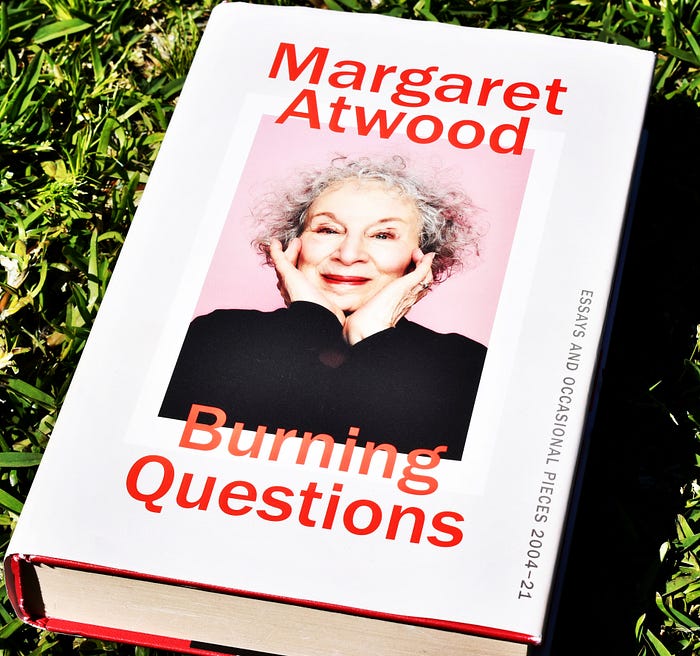
I have a confession to make. I have never read Margaret Atwood. Of course, I know what some of her books are about, especially cultural icons such as The Handmaid’s Tale, but I have never cracked the spine of one. So why did I pick up her latest collection of essays and other writing, Burning Questions? Perhaps it was the clever eyes peering at me from the cover.
Burning Questions: Essays and Occasional Pieces 2004–2021 is a journey through the last twenty years of Atwood’s writings, containing book reviews, speeches, and tributes to fellow writers. It is her third such collection, each spanning the same timeframe. In her introduction, Atwood states Burning Questions begins in an increasingly changing world: “After 2001, with the terrorist attacks on the Twin Towers and the Pentagon, everything changed. Former assumptions were challenged, former comforts flew out the window, former truisms were no longer true.” Her focus, therefore, is the important questions we must ask ourselves in our first tumultuous twenty years of this century. And the questions are many.
For Atwood, many of these questions relate to the relationship between humans and the environment. Atwood’s passion for this topic is not surprising, given her early life in Canada with her research entomologist father. In her speech “Wetlands,” given at the Charles Sauriol Environmental Dinner in 2006, Atwood states that for much of her youth she: “…led the kind of double existence that used to be more typical of Canadians — part-time in the boreal forest, part-time in cities.” As such, Burning Questions contains numerous pieces that reflect on human impact on the environment. She makes her stance clear in “How to change the world”: “We are a part of Nature: we are not apart from it.” Yet, “No one wants to go first. No one wants to sacrifice ‘economic growth’ and the risk of the wrath of the populace.” Though some are near twenty years old, these pieces on the environment remain relevant today. Her thoughts are well researched and persuasive, which is to be expected of a writer of her calibre and reputation; she has been a writer since college, and now on her first page modestly calls herself “…a fairly well-known writer…”
As “…a fairly well-known writer…,” it is expected that many of her pieces are also filled with questions about the writer’s place in the world. Atwood does not disappoint here and is generous with her advice; despite her talent and fame she does not paper over her work with the trope of “artistic genius.” In the piece “5 Visits to the word-hoard”, a speech given in honour of Robert Bringhurst, she reassuringly tells us: “There’s knowing what and there’s knowing how, and the how comes from years of practice and failure…” Her thoughts on the writer and their relationship to the world are interesting and peppered throughout the collection. She makes mention of those writers who are not so free to pursue their truth: a particularly inspiring piece is “Ryszard Kapuściński ”, written about Kapuściński’s death. Don’t, however, expect her to tell you what the writer must do; “Must breaks the bond between the writer, such as me, and you yourself, Mysterious Reader: For in whom can you place your readerly trust if not in me, the voice speaking out to you from the page or screen right now?” Truth is at the heart of all things for Atwood.
I have left the most interesting topic of Burning Questions until last: Atwood’s writings about her portentous text The Handmaid’s Tale and the question of how it relates to the world today. To the reader in the latter half of 2022, these provide a fascinating insight into the background and inspiration for its writing. It was also the source of the only serious letdown of the compilation: that it did not stretch for another year or two. What would Atwood have to say about the repeal of Roe V Wade in The United States and how it relates to her well-known work? Contrary to some claims though, Atwood is not psychic. She clearly states her work comes from the behaviour and history of humans: “…it is not I that came up with this weird shit. It is human beings, and they have come up with a large amount of shit much weirder than anything I have put into The Handmaid’s Tale or The Testaments”. Atwood appears only to have the inkling that the decision was a possibility. What was not an inkling was the Covid-19 pandemic, which started two years before the end of Burning Questions’ twenty-year span. However, only one piece directly reflects on it: “Growing up in Quarantineland.” While it is disappointing considering the pandemic’s impact current cultural zeitgeist, the essay again displays Atwood’s historical knowledge and research: “…we’ve been here before, or if not here, somewhere eerily like it” she reassures.
While Burning Questions spans the past twenty years, it is essential reading for both writers and those who wish to understand their place in the world. Atwood writes with humour, intelligence, and grace. She succeeds in making you think about the world around you and how we got here. Enough that I will be working through her back catalogue.
(Margaret Atwood, Burning Questions: Essays and Occasional Pieces 2004–2021, published by Chatto & Windus, 2022)
 Lucy Irene
Leave a comment