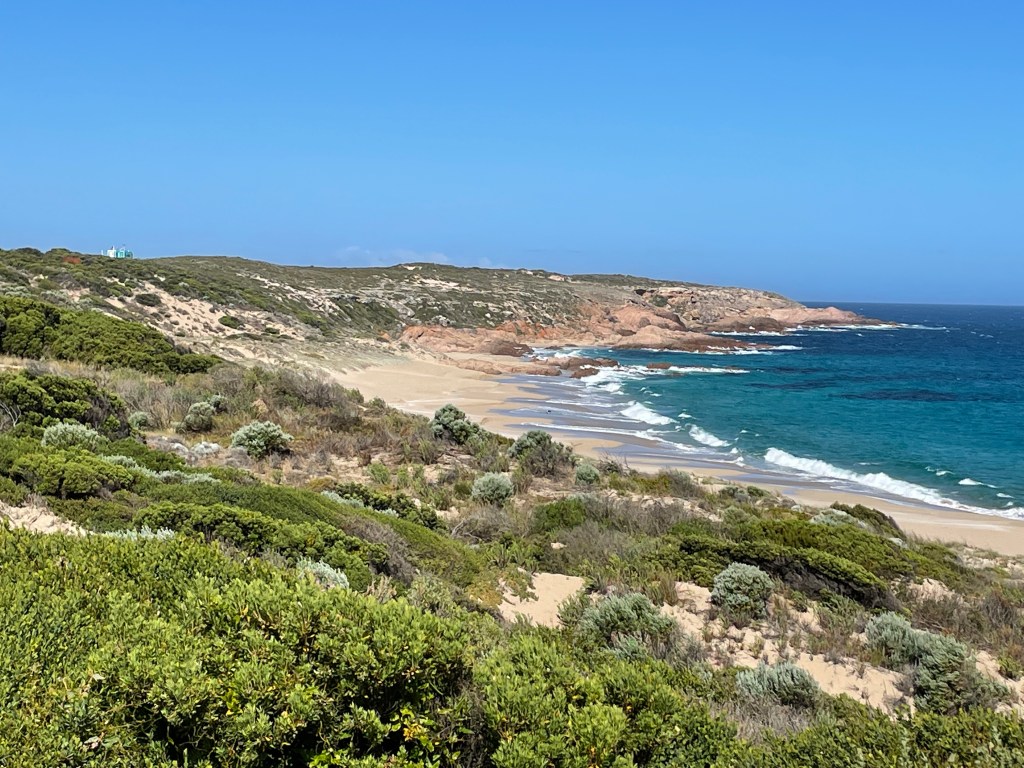
That night, I dreamed that the cabin had slipped its perch on the dunes and was being thrown around on the violent waves of the ocean. The water was lapping a deep blue against the window, and no one was coming to save us. I woke up in a panic, until I realised that the waves I could hear were not surrounding the cabin, but on the beach a short distance away. Everything was still right with the world.
I had spent the previous day in the water.
Sitting in the small natural rock pool on the edge of a violent ocean, I was so still that the small silver fish played around my body. For the first time in a long time, I was home. More accurately, it was the first time in a very long time that I had sat in the grips of nature instead of scrolling mindlessly through my phone. After all, you can’t take your phone in the ocean with you.
I had no phone signal, anyway. I had chosen our hideaway, perched on the dunes on the southern tip of the Yorke Peninsula, for that exact reason. It wasn’t the spectacular views or the nearby pub with delicious food and a cool vibe. It was that I was blissfully away from the world. The world couldn’t touch me. I was unreachable.
I had spent most of 2021 incredibly stressed. The first year of the pandemic didn’t affect me; despite being an underpaid office worker, I was labelled “essential”. My life continued relatively normally. The second year was different. I was tired; while my work wasn’t difficult, it was unfulfilling, and the stress of the pandemic was wearing thin. Interacting with anyone at work had become difficult, and I was anxious all the time. Coupled with the stress of a postponed wedding, studying at university, and the knowledge that I would not be mourned at work if I left, I did just that. I found another job and went on what was supposed to be my honeymoon. I thought it would be good to be away from everything, especially an internet connection and the ability to mindlessly scroll on social media.
I knew that my endless scrolling had turned into something negative. Though I am loathe to admit it, I am old enough to remember when the internet wasn’t so readily available. We didn’t really have it in my family home until I was well into my teens. Instead, I remember ploughing through long books, some part of an epic thirteen-book long fantasy series, and actually remembering what I read. I built a lifelong passion for reading that I originally thought would overrule the distraction of the emerging digital world. Until, suddenly, it didn’t. I noticed I had lost my attention span completely.
Feeling lost without reading and unable to focus, I ironically turned to the internet to find a solution. I came across Nicholas Carr’s 2008 article ‘Is Google making us stupid?’ in The Atlantic, where they lament that reading now is not as easy as before due to their concentration wandering. I felt seen, and I knew I was not alone. I knew that what I was facing was entrenched in how we live today. Soon after, in early 2021, I listened to Cal Newport’s relatively new book, Digital Minimalism, and was taken by his idea that I could improve my life by disconnecting. By being more “intentional”.
I just needed a kickstart.
*
Constant phone scrolling is something that has become so widespread it can be considered standard behaviour. It’s often used as a coping mechanism in times of stress and mental overload. The events of the last few years have only made blindly scrolling for comfort more habitual. The Covid-19 Pandemic, climate events such as the Black Summer fires, the war in Ukraine, and financial instability are constantly front of mind. By scrolling through both news and social media, we seek to avoid the feelings of anxiety these events bring with them. We trick ourselves into feeling like we have some control over our lives, that we are informed and prepared, instead of feeling as if we are being tossed about in a small cabin on the ocean with no one coming to save us.
The act itself is rewards-based. We search for things that make us happy, make us laugh, or just generally things that we like on an infinite feed. We interact with this content by liking and commenting on posts, indicating to social media companies what we want to see more of, so they can personalize our feeds and keep us scrolling as we continue our search. We do this even if it is at odds with what we are doing or want to do. Our attention span gets shorter: if something doesn’t entertain us immediately and completely, we are ready to scroll to the next thing. The long and complex fantasy series of my youth can’t stand up to the immediate satisfaction of TikTok. Hell, if the TikTok is longer than twenty seconds I scroll on. I’ve already experienced sitting in the ocean, why would I want to do it again? For longer than five minutes? Shouldn’t I be on the hunt for the next experience?
In trying to silence our anxious brains, we only make them more noisy, anxious, and ultimately burnt out. Only to keep going for the next hit.
*
So, I had taken myself to the ocean feeling that I needed the time to disconnect from my phone and reconnect with nature. I knew that it would be good for me, and I had always loved the ocean, nearly as much as I loved reading. I knew that using social media to calm my anxieties was essentially a fool’s game. Humans as a whole spend too much time thinking that they are apart from nature rather than a part of it and that for me closing that growing gap would help. I would disconnect from socials and spend some time in nature, and I would come back with balance in my life and ready to start a new chapter.
Wrong.
As soon as I left the cabin, and was in range, the phone notifications started going off. The months started to go by, and my scrolling habits got worse than before. My new job was emotionally draining, and life, in all its stressful glory continued. I kept researching how to get better and unplug, but everything I read online didn’t stick. Again, ironic. Most of what I read referred to personal responsibility and productivity and ignored the far deeper issues that I was experiencing. That I was living a life that was very different from the one that I wanted to, out at my beach cabin. For me, as well as many others, the need to disconnect from social media was not an issue of increasing my productivity at work, but that everything was out of balance. I was back in the ocean of my nightmare, not the calm rock pool.
It seemed easy for the people around me to tell me to just take the social media apps off my phone, install timers and turn off my phone completely. Be uncontactable. Maybe move to my own cabin instead of renting one for a week if I was so at peace there. It’s not that easy in the real world though. One time, when I deleted my Facebook account, my boss accused me of unfriending them, an act that was so insulting to them that they felt the need to verbally confront me. For my parents, my being uncontactable would worry them, a fact that I begrudgingly understand given my long work commute and the anxiety-inducing evening news. Career-wise, I am trying to put myself out there as a writer, which needs some kind of presence when you don’t have the privilege of an already established career. There is almost no practical way to go so “off-grid” long term. The need to be digitally contactable and present is so entrenched in our society that it’s near impossible to avoid, and severely limiting if you can pull it off.
I can’t afford a beachfront off-grid cabin anyway.
*
I am now on my third read-through of Newports’ book, and honestly, I feel like finding out his address and sending him an angry letter. I delete and add social media apps to my phone constantly. Once, in the early hours of the morning after a particularly draining day, my husband found me on my phone scrolling mindlessly through TikTok, dark shadows under my eyes.
I’ve realised it’s not an entirely lost game though. I have a camping road trip booked following The Great Ocean Road, and I will be blissfully free of my phone for a week. While I sometimes scroll long into the night, I can just as often be found with a book in my hands. Now and then, you can even find me sitting quietly. I’m working to establish good habits, on my own terms, in the hope that one day they outweigh the bad ones. While my kick start in the beachside cabin didn’t quite work out as I wanted it to, my slow, small steps are bringing me closer to the quiet of the rock pool. For now, at least, the ocean will always be there when I need it.
 Lucy Irene
Leave a comment